The Mathematics Outlet · Video summary
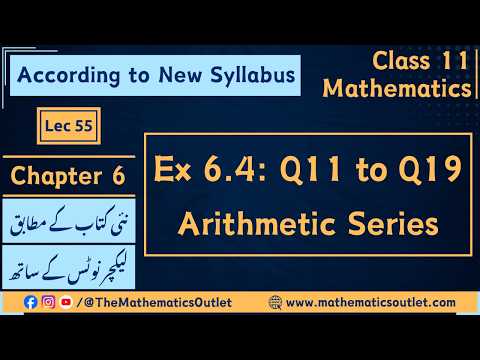
11th Class Math New Book 2025 | Ex 6.4 Q11 to Q19 | Arithmetic Series || Lec 55
Master arithmetic series concepts, including formulas for sum and general terms, and apply them to solve problems like finding missing terms, determining numbers in a sequence, and proving properties of APs.
 Watch on YouTube ↗
Key takeaways
- 🚀When given information about terms and sums in an AP, systematically set up equations using the general term ($a_n = a_1 + (n-1)d$) and sum formulas ($S_n = \frac{n}{2}(2a_1 + (n-1)d)$) to solve for unknown variables like $a_1$ and $d$.01:31
- 🎯The general term formula for an arithmetic progression, $a_n = a_1 + (n-1)d$, is fundamental for finding any term, but requires knowing the first term ($a_1$) and the common difference ($d$).02:12
- 💡When finding three numbers in an arithmetic progression (AP) given their sum and product, representing them as $a-d, a, a+d$ simplifies calculations because the $d$ terms cancel out in the sum.07:41
- 🔧When finding multiple numbers in an AP, strategically choose the representation of the terms (e.g., $a-d, a, a+d$ for three terms) to simplify algebraic manipulations, especially when sums or products are involved.07:41
- 📈To find the least number of terms ($n$) needed for the sum of an AP to exceed a certain value, set up the inequality $S_n > Value$ and solve for $n$, remembering that $n$ must be an integer.15:05
- 💪To find the number of terms ($n$) required for the sum of an AP to exceed a value, solve the inequality $S_n > Value$, remembering to consider that $n$ must be a positive integer.18:05
Chapters
- 0:00📝 Introduction and Review of Formulas
- 0:591️⃣ Question 11: Finding the 18th Term
- 7:262️⃣ Question 12: Finding Three Numbers in AP
- 14:383️⃣ Question 13: Least Number of Terms for Sum > 2000
- 19:524️⃣ Question 14: Finding Four Numbers in AP
- 24:045️⃣ Question 15: Finding Five Numbers in AP
- 32:336️⃣ Question 16: Proving Squares are in AP
- 39:417️⃣ Question 17: Finding Total Number of Terms
- 47:098️⃣ Question 18: Proving the Sum Formula
- 53:59🏁 Conclusion of Exercise 6.4
The digest
This detailed lecture focuses on solving questions 11 to 19 from Exercise 6.4, covering Arithmetic Series for 11th class mathematics. It explains problem-solving techniques related to arithmetic progressions (AP), including calculating terms, sums, and using formulas effectively. This content is essential for students preparing for board exams or anyone seeking a strong foundation in arithmetic series concepts and applications.
High-Level Overview
The session deepens understanding of arithmetic series by walking through a sequence of problems involving finding specific terms, sums, and unknown values within arithmetic progressions. Emphasis is placed on applying standard formulas, manipulating equations, and interpreting conditions such as sums of terms, products of terms, and arithmetic means. The lecture is targeted at high school students engaged with the 11th-grade syllabus but also serves as a thorough refresher on arithmetic progression fundamentals.
Keep reading in The Digest
The full 6-minute article, 16 more sections, and every new episode from The Mathematics Outlet and the creators you follow.
- Structured Deep Dive
- Recap of Key Formulas (00:20 - 00:59)
- Problem 11: Finding the 18th Term Given $a_5$ and $S_6$ (01:00 – 07:17)
- Problem 12: Finding Three Numbers in AP Given Sum and Product (07:26 – 14:32)
- Problem 13: Least Number of Terms for Sum > 2000 (14:33 – 19:52)
- Problem 14: Find Four Numbers in AP Given Sum and Sum of Squares (19:53 – 24:01)
- Problem 15: Find Five Numbers in AP Given Sum and Sum of Squares (24:02 – 32:33)
- Problem 16: Proving $a^2, b^2, c^2$ are in AP if $1 + b, 1 + c, 1 + a$ are in AP (32:34 – 39:42)
- Problem 17: Finding Total Number of Terms Given Sums of First and Last Four Terms (39:43 – 47:09)
- Problem 18: Expressing Sum of an AP using $a$, $b$, and $c$ (47:10 – 49:45)
- Problem 19: Proving Sum of n Arithmetic Means Between $a$ and $b$ Using AM Formula (49:46 – 54:17)
- Key Frameworks and Mental Models
- Arithmetic Progression (AP) Fundamentals
- Approach to Problems
- Practical Implications & Takeaways
- Action-Oriented Summary: How to Apply These Insights
More from The Mathematics Outlet

Class 11 Math New book | Ex 7.2 Q6 to Q15 | Permutations || Lec 76
This video explains permutations and their applications in solving arrangement problems, including scenarios with restrictions and groupings of items.

Thomas calculus chapter 8 exercise 8.3 Q69 to Q76 | Trigonometric Integrals || Lec 34
This video covers calculus problems from Thomas' Calculus, focusing on arc length, center of gravity, and volume of revolution for trigonometric and logarithmic functions.
Class 11 Math New book | Ex 7.2 Q1 to Q5 | Permutations || Lec 75
Master permutations as ordered arrangements using the formula $P(n, r) = n! / (n-r)!$. Learn to solve problems involving distinct arrangements and derive unknown values.

Class 11 Math New book | Ex 7.1 Complete | Principle of Counting | Factorial || Lec 74
Learn the Fundamental Principle of Counting and Factorials to solve permutation and combination problems, with practical examples and detailed exercise solutions.

Class 11 Math New book | Ex 6.11 Q9 to Q15 | Applications of sequences and series || Lec 73
Learn to apply sequences and series to real-world problems like depreciation, car overtaking, worker productivity, and compound interest, using formulas and understanding their underlying patterns.

Thomas calculus chapter 8 exercise 8.3 Q57 to Q62 | Product of sines and cosines || Lec 32
Learn to integrate products of sines and cosines using trigonometric identities to simplify expressions before applying standard integration rules.